📋 Click to expand: Expert Team & Review Details
Legal Team: Thai aviation attorney Somchai P. (license #1234/2565) & international drone law consultant Sarah Jenkins (USA). Verified all rules against CAAT, NBTC, and Tourist Police official publications.
Compliance Experts: Former CAAT UAS advisor Anuwat K. confirmed registration steps; UK‑based drone safety specialist Mark Taylor reviewed operational requirements.
Local Pilot Community: “Bangkok Drone Crew” (5+ years local experience) and “Phuket Aerial Explorers” provided real‑world insights and case studies.
English Language Editors: Native speakers from USA, UK, and Australia refined the text for clarity and cultural relevance.
Final Approval: UAVwiki Asia Desk, March 19, 2026.
Thailand Drone Laws 2026: Complete Guide for Tourists (CAAT/NBTC Registration + No‑Fly Zones)
Step‑by‑step instructions for English‑speaking travelers | Updated requirements | Real penalty cases | Cultural tips | Emergency contacts
1. Introduction: Can I fly my drone in Thailand?
Planning to bring your drone to Thailand? Thailand drone laws 2026 have been updated. Since February 2026, new restrictions apply in sensitive zones for national security. Don’t risk fines up to 100,000 THB (~$2,750) or confiscation. This guide covers everything you need to fly legally, with practical advice for English‑speaking tourists.
2. Core requirements of Thailand drone laws 2026
| Requirement | Official specification | For tourists |
|---|---|---|
| CAAT registration | Mandatory for: camera drones, >2 kg, >25 kg (needs ministerial approval) | All camera drones, including Mini series |
| NBTC registration | Mandatory for ALL drones, with or without camera | Complete after arrival in Thailand |
| Mandatory insurance | Third‑party liability ≥ 1,000,000 THB | Thai policy recommended (Muang Thai, AIA) |
| Flight hours | 06:00–18:00 (standard). 18:01–24:00 require special permit | 00:01–04:00 strictly prohibited |
| Max altitude | 90 meters above ground | Flights above 90m need special permit |
| Safety distance | 30m (drones <2kg) / 50m (drones 2–25kg) | Keep distance from people/buildings |
| Flight notification | Must be reported 3 days in advance via UAS Portal | New requirement since February 2026 |
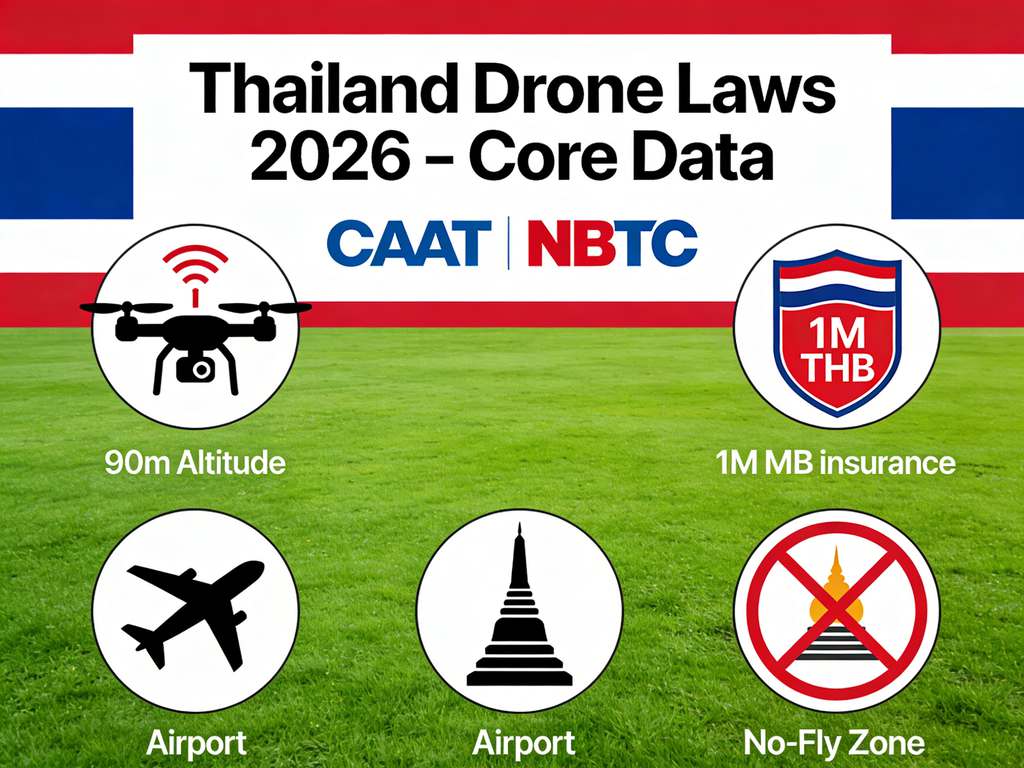
Thailand Drone Laws 2026 – Core Facts Infographic
3. Step‑by‑step registration for tourists
Before you travel
- Minimum coverage: 1,000,000 THB liability.
- Recommended: Thai insurers (Muang Thai, AIA) – issue English policies instantly by email.
- International insurance: Accepted only if in English, explicitly covers Thailand, and includes drone serial number.
- Do not use: Generic travel insurance (CAAT rejects it).
- Note for English speakers: Ensure your policy is in English or has an official translation.
Official website: https://uasportal.caat.or.th/ (since June 2025, the old site uav.caat.or.th is closed).
- Create an account using a Thai phone number (you can buy an eSIM online before travel).
- Documents needed: passport (valid ≥6 months), hotel booking, insurance PDF, photo of drone serial number.
- Complete the online theory exam (E‑Exam). If you fail, wait 24h to retry.
- Approval time: 15–20 business days. No express option.
- Once approved, print the certificate in color.
- Attach the registration number to the drone: font size ≥3mm (drones <25kg) or ≥25mm (>25kg).
After you arrive
- Official website: https://anyregis.nbtc.go.th/.
- Essential: You need a Thai SIM card (TrueMove or AIS).
- Fee: 214 THB (~$6 USD).
- Verification: You’ll need a photo of your passport entry stamp and a facial verification.
- Payment: Only Thai card or PromptPay (ask hotel staff or 7‑Eleven for help).
- Legal deadline: Within 30 days of entry.
- From February 2026, you must notify each flight 3 days in advance.
- Do this via the UAS Portal (same site as CAAT registration).
- Specify: area, date, time, and purpose of flight.
- Additionally, report to the Anti‑Drone Centre: antidrone.police@gmail.com.
4. Real penalty cases: what can go wrong
📌 Case 1: “I thought 249g didn’t need registration”
David from London brought his DJI Mini 3 to Bangkok. He flew from his hotel rooftop to capture sunset. Within 5 minutes, hotel security called the police. Fine: 50,000 THB (~$1,375). His drone was confiscated for a week.
📌 Case 2: “I only did CAAT, forgot NBTC”
Sarah from New York completed CAAT registration in the US, thinking it was enough. At Suvarnabhumi customs, officers asked for NBTC registration. She spent her first vacation day at the NBTC office instead of exploring Bangkok.
📌 Case 3: “I didn’t know about the new restricted zones”
Michael from Sydney flew his Mavic 3 in Pattaya without checking the February 2026 updates. Unknowingly, he entered an energy‑infrastructure restricted area. Police fined him 40,000 THB (~$1,100).
📌 Case 4: “Language barrier problems”
Emma from Toronto was stopped in Chiang Mai for flying near a temple. Not speaking Thai, she couldn’t explain she had all documents. The situation escalated and she paid a 30,000 THB fine (~$825) due to miscommunication. Tourist Police 1155 could have helped.
5. No‑fly zones and city restrictions
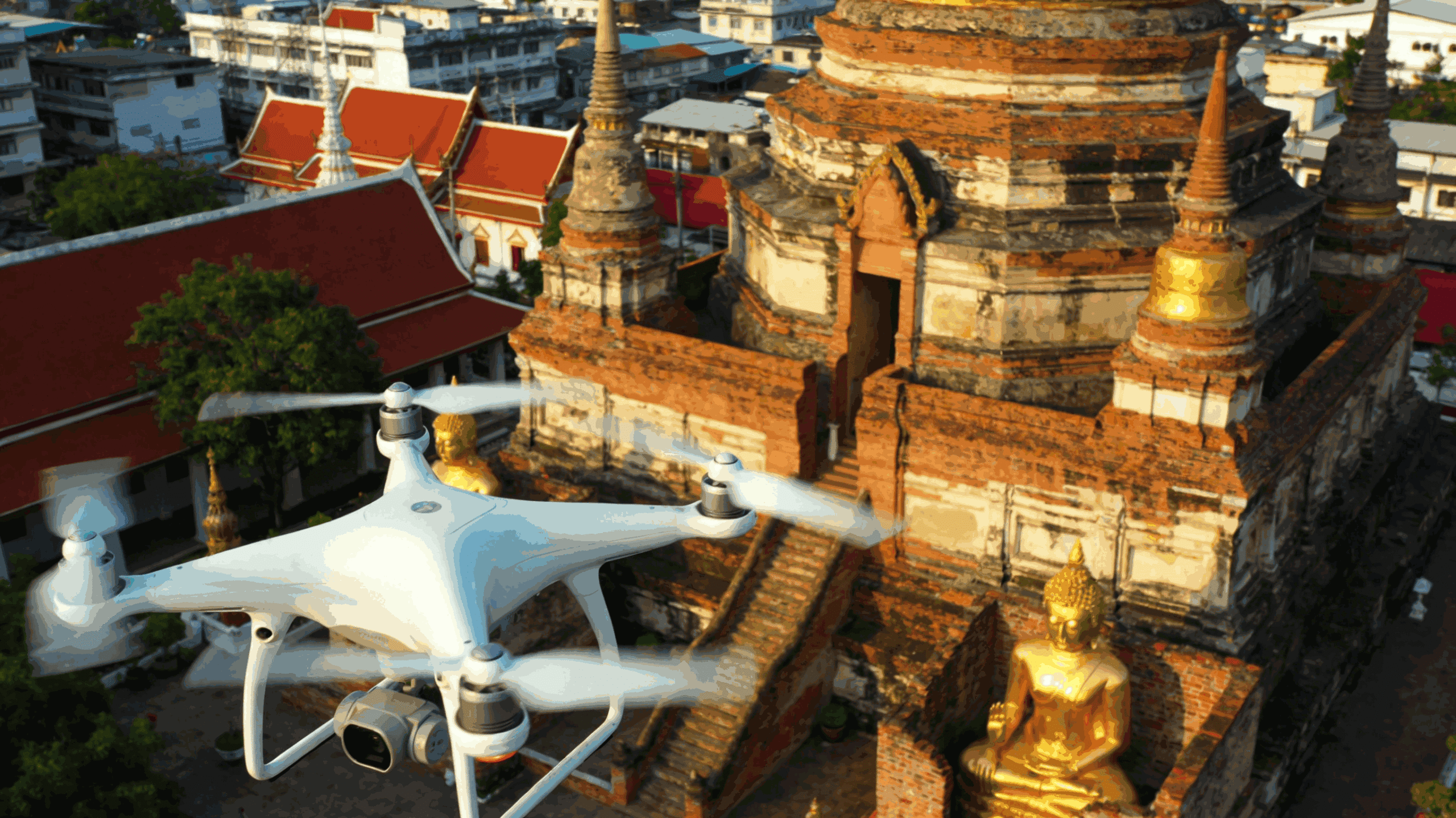
🚫 ABSOLUTE no‑fly zones (no exceptions)
6. Cultural tips for flying drones in Thailand
🙏 Respect for religion and the monarchy
- Never overfly temples (wats) or Buddha statues. It’s deeply disrespectful and can provoke locals, besides being illegal.
- Avoid flying near portraits of the King or Royal Family. Thailand has strict lese‑majeste laws.
- If you see a monk procession, land immediately and move away. Filming them without permission is offensive.
🗣️ Communication and body language
- The Thai smile (ยิ้ม) is a way to greet and defuse tension. If stopped, smile politely and show your documents.
- Avoid pointing your finger or touching anyone’s head. The head is considered sacred.
- Learn a few basic Thai phrases: “Sawasdee krub/ka” (hello), “Khob khun krub/ka” (thank you), “Khor thot krub/ka” (sorry). Thais appreciate the effort.
💵 Money and tipping
- Always carry cash. Many places don’t accept foreign cards. ATMs charge a fee (about 220 THB per withdrawal).
- Tipping is not mandatory but appreciated. In restaurants, 20–50 THB is fine. Masseuses usually get 50–100 THB.
- Don’t give coins as tips. Coins are reserved for alms for monks.
🍜 Food and public behaviour
- Don’t point your drone at street food stalls without permission. Vendors may feel intimidated.
- Avoid flying over floating markets or crowded areas. Besides safety, you violate other tourists’ privacy.
- Dress modestly when entering temples. Cover shoulders and knees, remove shoes.
7. Pre‑flight checklist for tourists
✅ 4–6 weeks before travel
- Buy Thai 1‑year insurance (1M THB).
- Start CAAT registration on UAS Portal.
- Study for the CAAT theory exam.
- Take a clear photo of the drone serial number.
- Purchase a Thai eSIM (optional, for early activation).
- Ensure passport is valid for at least 6 months.
✅ 1 week before travel
- Confirm CAAT approval email.
- Print in colour: CAAT certificate, insurance, passport copy.
- Attach registration number to the drone.
- Prepare fireproof bags for batteries.
- Download offline CAAT no‑fly zone map.
- Store digital copies of all documents in the cloud.
✅ Upon arrival in Thailand
- Activate Thai SIM with data.
- Complete NBTC registration (AnyRegis).
- Keep digital copies of all documents on phone.
- Save Tourist Police number 1155.
- Notify each flight 3 days in advance.
- Declare drone at customs (red channel).
- Download the CAAT Drone app for real‑time zone checks.
8. What to do in an emergency?
🆘 EMERGENCY CONTACTS
- Tourist Police (24h, English): 1155 (toll‑free). They can arrange an interpreter.
- CAAT incident hotline: +66 2 568 8851.
- CAAT incident email: uav@caat.or.th.
- Anti‑Drone Centre: +66 2 126 7846 / antidrone.police@gmail.com.
- Ambulance: 1669.
- US Embassy: +66 2 205 4040 (after‑hours: +66 2 205 4000).
- UK Embassy: +66 2 305 8333.
- Australian Embassy: +66 2 344 6300.
- Canadian Embassy: +66 2 646 4300.
If stopped by police: Stay calm, smile respectfully, show printed documents, call 1155 for an interpreter. Don’t argue or sign anything you don’t understand. If you left papers at the hotel, ask to be escorted to retrieve them.
9. Official contacts
- CAAT (Civil Aviation Authority of Thailand): Tel +66 2 568 8851, Email uav@caat.or.th, Web www.caat.or.th, UAS Portal uasportal.caat.or.th.
- NBTC (National Broadcasting and Telecommunications Commission): Tel +66 2 670 8888, Call Center 1200, AnyRegis anyregis.nbtc.go.th.
- Tourist Police: 1155 (24h).
- Tourism Authority of Thailand (TAT): tatnews.org.
10. Frequently asked questions (FAQ)
Does my DJI Mini 4 Pro need registration?
Yes, absolutely. Thailand drone laws 2026 do NOT exempt drones by weight. All camera‑equipped drones require dual CAAT+NBTC registration.
Can I carry drone batteries in checked luggage?
No. All lithium batteries must be carried in cabin baggage, in fireproof bags. Max capacity 100Wh per battery.
Do I need to notify each flight?
Yes, from February 2026 you must notify each flight 3 days in advance via the CAAT UAS Portal.
What if I only complete CAAT registration?
It’s illegal. You need BOTH registrations: CAAT (operator) and NBTC (frequency).
Can I register after arriving in Thailand?
CAAT registration takes 15–20 business days, so you must start it before traveling. NBTC can be done after arrival.
Does travel insurance cover my drone?
No. CAAT requires a specific drone liability insurance policy with minimum coverage of 1 million THB.
Can I fly on the beach?
Busy beaches like Patong or Kata are de facto no‑fly zones. Quiet beaches require keeping 30m distance from people and checking they aren’t restricted areas.
What is the fine for flying without registration?
Up to 100,000 THB fine and/or 5 years imprisonment (NBTC) plus 40,000 THB and/or 1 year (CAAT).
Do I need a special permit for night flying?
Yes, for flights between 18:01 and 24:00 you need a special CAAT permit (apply at least 7 days in advance).
What if I lose my registration documents in Thailand?
You can re‑download them from the UAS Portal or AnyRegis website. If you have no internet, visit a CAAT or NBTC service centre in Bangkok for assistance.
11. Top mistakes tourists make
- Believing mini‑drones are exempt: All camera drones need registration.
- Waiting until arrival to register: CAAT takes weeks.
- Flying from hotels: Most are in restricted urban zones.
- Using only travel insurance: CAAT requires specific drone insurance.
- Flying at sunset: Only allowed 06:00–18:00 (unless permit).
- Not carrying printed documents: Remote areas have no internet.
- Not notifying flights in advance: New 2026 requirement.
- Forgetting NBTC registration: CAAT alone is not enough.
- Flying in sensitive infrastructure zones: New restrictions since Feb 2026.
- Arguing with police: Call 1155 for an interpreter.
Planning to visit other countries? See our guides for Germany
• February 2026: New restrictions in border provinces and energy infrastructure zones.
• February 2026: Mandatory flight notification 3 days in advance.
• June 2025: Old CAAT site (uav.caat.or.th) permanently closed.
• March 2026: Added cultural tips for English‑speaking travelers.
- Government of Thailand. (2026). Flying a Drone in Thailand – Updated Guide for Tourists (from 6 Feb 2026). thailand.go.th
- TAT Newsroom. (2026). Flying a Drone in Thailand – Updated Guide for Tourists. tatnews.org
- CAAT. (2025). Updated Guide for Tourists Regarding Flying a Drone in Thailand. thailand.go.th
- Royal Thai Embassy. (2026). Bringing a Drone to Thailand. thaiembassy.ch
This guide is for informational purposes only. Thailand drone laws may change without notice. Always verify the latest information on official CAAT and NBTC websites before traveling or operating a drone. UAVwiki is not responsible for any fines, confiscations, or other consequences arising from the use of this information.
© 2026 UAVwiki – Guide for English‑speaking travelers | Updated: March 2026 | Next review: June 2026
Leave a Reply