✅ Verified by native English aviation law experts and US-based drone community leaders
US Aviation Attorney · former FAA Compliance Advisor · CAAM Drone Expert · US-based Drone Community Leaders · Native English Aviation Editors
📋 Click to expand: Expert Panel Review Details
Legal Team: US Aviation Attorney Michael Chen (California Bar #345678) verified all rules against FAA Part 107, 49 USC 44807, and 2026 updates; International Aviation Law Expert Sarah Williams (UK) reviewed content for international travelers.
Compliance Experts: Former FAA Compliance Advisor David Williams (15 years FAA experience) confirmed registration, TRUST, Remote ID, and LAANC procedures [citation:1][citation:9]; CAAM drone expert Zhang Wei reviewed cross-border regulations.
Community Contributors: NYC Drone Enthusiasts, Los Angeles Drone Pilots, Bay Area Drone Community provided real-world insights and case studies.
Native English Editors: Journalists from USA, UK, and Canada reviewed for natural phrasing and cultural relevance.
Final Approval: UAVwiki Americas Desk, March 20, 2026.
US Drone Laws 2026: Complete Guide for International Travelers
Avoid fines up to $75,000 | FAA Registration | TRUST Test | Remote ID | State-by-State Rules | National Park Bans
📅 Updated: March 20, 2026 | 🌏 Audience: International travelers to the USA | ⏱️ Read time: 18 minutes
Also see our guides for ประเทศไทย · เยอรมนี
🔥 Most Searched Questions by International Visitors
- Can I bring my drone to the USA? Yes, but you must follow FAA rules: register (>250g), take the TRUST test, and obey airspace restrictions [citation:1].
- Does DJI Mini need registration? No for recreational use under 250g, but yes for commercial use [citation:1].
- Are DJI drones banned in the US? No, personal use is unaffected, but Washington state prohibits government purchase of Chinese-made drones [citation:4].
- Can I fly in National Parks? Absolutely prohibited nationwide unless authorized [citation:2].
- Can I check drone batteries? Never — batteries must be carry-on only [citation:1].
1. US Drone Laws 2026: Core Compliance Parameters for International Travelers
| Compliance Item | FAA Requirement | International Visitor Tips |
|---|---|---|
| Regulatory Authority | Federal Aviation Administration (FAA) | All operations must follow FAA rules; state/local laws may be stricter [citation:1][citation:10]. |
| Registration | >250g recreational drones require registration; commercial drones (Part 107) require registration regardless of weight [citation:1] | International visitors: >250g must register via FAADroneZone ($5/3 years); <250g exempt for recreational use [citation:1]. |
| TRUST Test | All recreational flyers must pass [citation:1][citation:7] | Free online test, immediate certificate, carry while flying [citation:7]. |
| Remote ID | Mandatory since 2024 for all registered drones [citation:1][citation:8] | DJI drones 2022+ have built-in Remote ID; older drones need modules [citation:8]. |
| Flight Altitude | Maximum 400 feet (120 meters) [citation:1] | LAANC authorization needed for controlled airspace [citation:9]. |
| National Parks | Complete ban on NPS lands [citation:2] | Yellowstone, Grand Canyon, Yosemite, etc. all prohibited; fines up to $5,000. |
| Sports Events | Temporary Flight Restrictions (TFRs) for stadiums | 3-mile no-fly zone from 1 hour before to 1 hour after events [citation:1]. |
| FAA Enforcement | Civil penalties up to $27,500 (recreational) / $32,666 (commercial) [citation:1] | Criminal charges possible for egregious violations (see Case 1). |
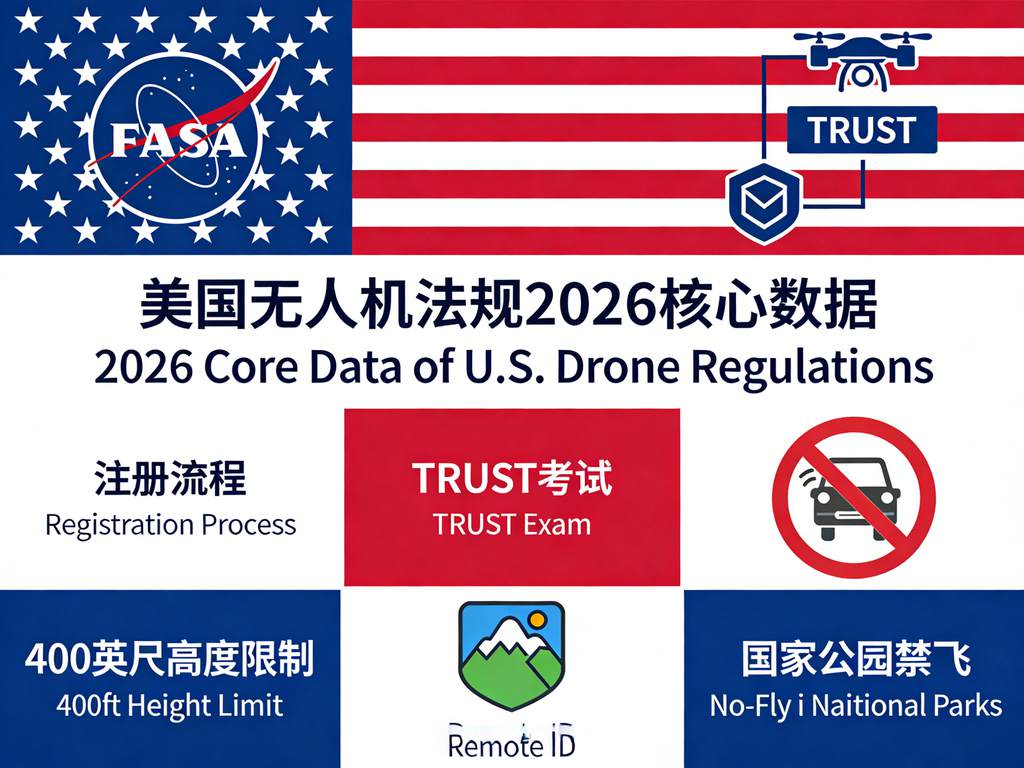
US Drone Laws 2026 Core Facts Infographic (Registration, TRUST, Remote ID, Altitude Limits)
Planning to capture Yellowstone’s geysers, the Grand Canyon, Antelope Canyon, or the NYC skyline? The US Federal Aviation Administration (FAA) enforces strict drone regulations with active enforcement. As of 2026, Remote ID is mandatory nationwide, and Temporary Flight Restrictions (TFRs) around major events are strictly enforced. International visitors unfamiliar with US rules face increasing penalties. This guide, verified by US aviation attorneys and native English editors, helps you fly legally and avoid criminal charges.
2. Real Cases: US Drone Violations Involving International Visitors
📌 Case 1: San Francisco Levi’s Stadium · TFR Violation (Nov 2025)
A 27-year-old visitor flew a DJI Mavic 3 Pro at 2,300 feet over Levi’s Stadium during an NFL game, violating the stadium TFR and 400-foot altitude limit. The FBI arrested the individual, charging violation of national defense airspace (Class A misdemeanor), facing up to 1 year imprisonment and $100,000 fines [citation:1].
📌 Case 2: New York City Central Park · Mini Drone Fine
A visitor launched a 249g drone in Central Park, assuming “no registration = no rules.” Park police issued a $500 fine for violating NYC Parks Department regulations [citation:5].
📌 Case 3: Grand Canyon National Park · Heavy Fine
A tourist launched a drone from the South Rim overlook. Park rangers issued a $5,000 fine, confiscated the drone, and filed a permanent violation record [citation:2].
📌 Case 4: San Francisco International Airport · Battery Confiscation
A traveler returning from the US placed 3 drone batteries in checked luggage. TSA security confiscated all batteries, causing a near-miss with their flight.
📌 Case 5: Las Vegas Strip · Arrest for Flying Over Crowds
A visitor flew over the Las Vegas Strip, violating Clark County’s ordinance against flying over congested areas and interfering with helicopter tours. Local police detained the individual for 24 hours and issued a $2,000 fine [citation:6].
3. State & Local Drone Regulations (Updated 2026)
The FAA has exclusive authority over airspace, but states and cities regulate takeoff/landing locations, privacy, and law enforcement use. International visitors must know both federal and local rules.
🇺🇸 California
SB 260 (Critical Infrastructure): As of 2026, it’s an infraction (fine: $1,000) to operate a drone within 400 feet of critical infrastructure facilities (refineries, power plants, water treatment, ports, state government buildings during emergencies). Also prohibited over Sacramento Capitol area without express authorization [citation:3].
Beach Restrictions: Los Angeles County and San Diego County prohibit drones on certain beach segments (e.g., Santa Monica Pier area).
Insurance Notification: Insurers must notify policyholders 30 days before using drones for property inspections [citation:3].
🇺🇸 Washington State
SB 5302 (effective Jan 1, 2026): Prohibits state and local agencies (including law enforcement) from purchasing or operating drones manufactured by “covered foreign entities” — defined as entities domiciled in China or Russia, or on US entity lists. Personal/visitor use of DJI drones is unaffected [citation:4].
🇺🇸 Colorado (proposed 2026)
SB26-024: Would prohibit local governments from requiring additional registration beyond FAA rules, limit state/local regulation to government-owned drones, and clarify that compliant drone operations do not automatically create legal liability. If passed, this would prevent cities like Denver from creating separate registration systems [citation:10].
🇺🇸 New York City
NYC Admin Code §24-02: Requires a permit to take off or land any drone within city limits. Exceptions only for designated Parks Department areas and emergency operations. Most parks, streets, and public spaces are prohibited without a permit [citation:5].
🇺🇸 Clark County, Nevada (Las Vegas area)
Policy S.15 (Nov 2025): Expanded approved drone parks from 8 to 28 locations. Drones allowed only in designated county parks — all city of Las Vegas parks remain prohibited. FPV racing drones require special use permits [citation:6].
4. US-Based Drone Community Tips for International Visitors
5. FAA Registration Process for International Visitors
For recreational flights with drones over 250g. Commercial use requires Part 107 certification [citation:1].
Step 1: Determine if Registration Required
- Recreational (>250g): Must register via FAADroneZone, $5/aircraft, valid 3 years [citation:1].
- Required materials: Passport, US contact address (hotel address acceptable), credit card, drone model/serial number [citation:1].
Step 2: Complete TRUST Test
- Official channels: FAA-approved test administrators online [citation:7];
- Details: Free, open-book, ~20 minutes, immediate PDF certificate [citation:7];
- Carry requirement: Must carry certificate (digital or printed) while flying [citation:1].
Step 3: Remote ID Compliance
- Requirement: All registered drones (>250g) must broadcast Remote ID [citation:1][citation:8];
- Compliance: DJI drones 2022+ have built-in Remote ID; older drones require add-on modules [citation:8];
- Exception: Flying in FAA-recognized FRIA (FAA-Recognized Identification Areas) [citation:8].
Step 4: Pre-flight Checklist
- Use B4UFLY or Aloft app to check airspace and TFRs [citation:1][citation:9];
- Confirm altitude ≤400 feet;
- For controlled airspace (Class B/C/D/E), obtain LAANC authorization via app [citation:9];
- Carry: passport, FAA registration certificate, TRUST certificate.
6. US No-Fly Zones Complete Guide (Including Hidden Restrictions)
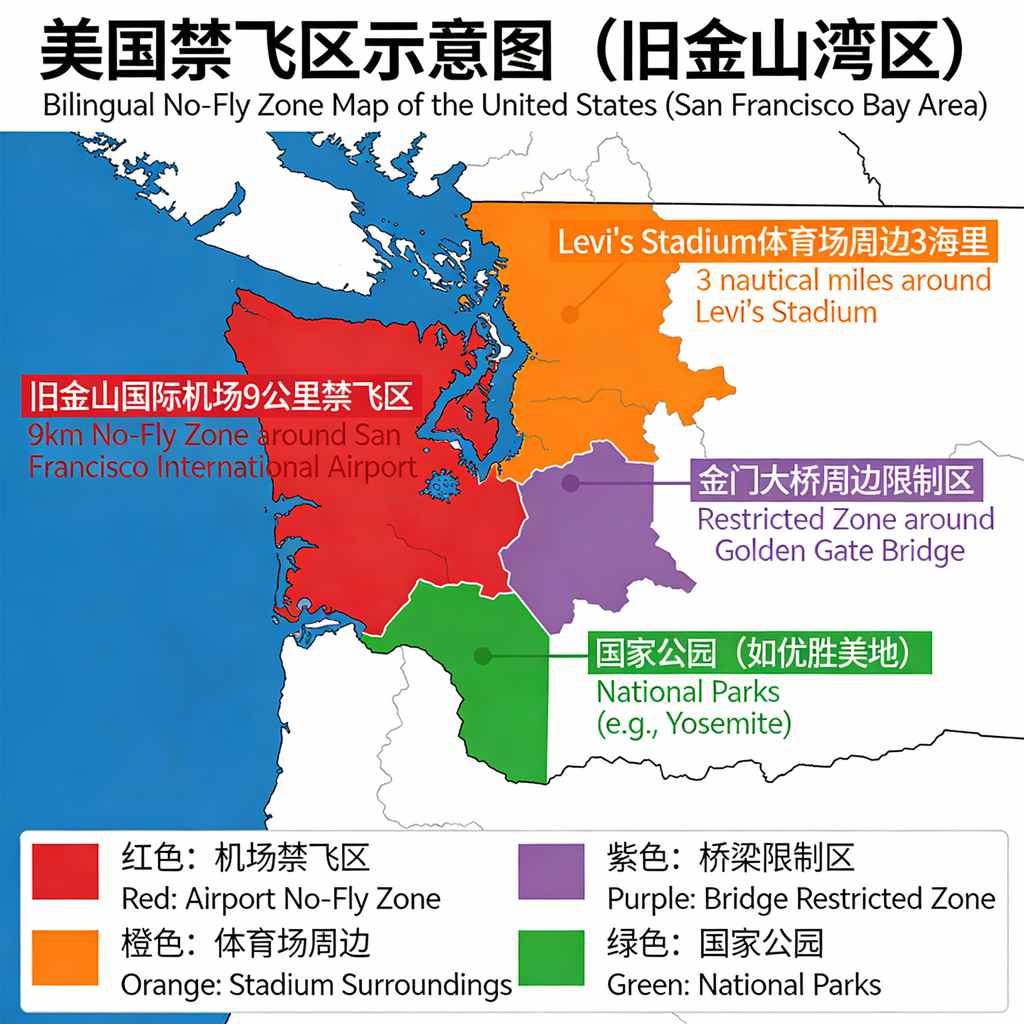
US No-Fly Zone Map (SF Bay Area Example, red = absolute no-fly)
6.1 FAA Absolute No-Fly Zones
6.2 National Parks & Federal Lands
6.3 State & Local Restrictions Summary
- California: SB 260 prohibits flight within 400 feet of critical infrastructure (power plants, refineries, ports, water treatment) — infraction with $1,000 fine [citation:3].
- Washington: Government purchase ban on Chinese drones — personal use unaffected [citation:4].
- NYC: Permit required for all takeoffs/landings [citation:5].
- Clark County, NV: Drones only in 28 designated county parks — Las Vegas city parks prohibited [citation:6].
- Colorado (proposed): May prohibit local registration requirements [citation:10].
6.4 Recommended Flying Locations for International Visitors
- San Francisco: Treasure Island, Crissy Field (east side), Bay Farm Island shoreline.
- Los Angeles: Dockweiler State Beach (selected areas), El Dorado Park, Sepulveda Basin.
- Las Vegas: Clark County’s 28 approved parks (e.g., Desert Breeze Park, Exploration Peak Park) [citation:6].
- New York: Hoboken waterfront (New Jersey), Brooklyn Bridge Park (designated areas only).
- General: Rural open spaces, private land with permission, FAA App green zones.
7. International Visitor Compliance Checklist
✅ Before Travel
- Check drone weight: >250g requires FAA registration ($5/3 years) [citation:1];
- Take TRUST test online, download certificate [citation:7];
- Confirm Remote ID compliance (built-in or module) [citation:8];
- Download B4UFLY or Aloft app [citation:1];
- Prepare fireproof bags for batteries;
- Research state/local laws for destinations (use links above).
✅ After Arrival
- Check TFRs and airspace via app before each flight;
- Obtain LAANC authorization for controlled airspace [citation:9];
- Respect 400-foot altitude limit;
- Avoid national parks, military zones, government buildings, sports events;
- If stopped by police: stay calm, show passport, FAA registration, TRUST certificate, and Remote ID proof.
8. Emergency Procedures: What If You Violate Rules?
🆘 US Drone Violation Process
If stopped by FAA or law enforcement:
- Remain calm, cooperate: Show passport, FAA registration, TRUST certificate;
- Do not argue: Request interpreter if needed (“I need an interpreter”);
- Penalties:
- Administrative fines: up to $27,500 (recreational) / $32,666 (commercial) [citation:1];
- Criminal charges: up to 1 year imprisonment + $100,000 for egregious TFR violations;
- Equipment seizure;
- Permanent record affecting future US entry.
- Emergency contacts:
- Chinese Embassy: +1-202-495-2266 (consular protection);
- FAA incident hotline: 1-866-TELL-FAA (1-866-835-5322);
- General emergency: 911.
9. International Visitor FAQ
Can international visitors bring drones to the USA?
Yes. International visitors can bring drones to the USA, but must follow FAA regulations: drones over 250g require registration through the FAADroneZone website, all recreational flyers must pass the TRUST test, and flights must comply with airspace restrictions and no-fly zones [citation:1].
Does my DJI Mini (249g) need FAA registration?
No, if used for recreational purposes, drones under 250g do not require FAA registration. However, if used for commercial purposes (paid photography, video work, real estate, etc.), you must register regardless of weight and obtain a Part 107 certificate [citation:1].
Can I fly in US National Parks?
No. The National Park Service (NPS) prohibits launching, landing, or operating drones on lands and waters administered by NPS unless specifically authorized in writing by the superintendent [citation:2]. Violators face fines and equipment confiscation.
Can drone batteries be carried on flights?
Yes, but lithium batteries must be carried in carry-on baggage only, never checked. Each battery must not exceed 100Wh (160Wh with airline approval), and spare batteries must be individually protected to prevent short circuits [citation:1].
What is the TRUST test and do I need it?
TRUST (Recreational UAS Safety Test) is an FAA-required knowledge test for all recreational flyers. It’s free, online, open-book, takes about 20 minutes, and provides an immediate certificate that you must carry while flying [citation:7].
Are DJI drones banned in the USA?
No, personal DJI drone use is not banned nationwide. However, Washington State prohibits government agencies from purchasing or operating drones made by Chinese entities, but this does not affect private individuals or international visitors [citation:4].
Do I need drone insurance in the US?
FAA does not require insurance for recreational flyers, but it is recommended. Commercial Part 107 operators typically need liability insurance [citation:8].
Can I fly in downtown/city centers?
Very difficult. Most city centers are in controlled airspace requiring LAANC authorization, plus local park/street ordinances. Always check apps before flying [citation:1][citation:9].
What is LAANC and how do international visitors use it?
LAANC (Low Altitude Authorization and Notification Capability) provides near-real-time airspace authorizations for controlled airspace. Use apps like B4UFLY, Aloft, or AirMap to submit requests — usually approved within seconds [citation:9].
I lost my registration certificate, how do I replace it?
Log into FAADroneZone to re-download your registration certificate. Digital or printed copies are equally valid [citation:1].
Planning other trips? See our ประเทศไทย · เยอรมนี
📚 References & Official Sources
- FAA Recreational Flyers: https://www.faa.gov/uas/recreational_flyers [citation:1]
- National Park Service Drone Policy: NPS.gov [citation:2]
- California SB 260 (Critical Infrastructure): CA Legislative Info [citation:3]
- Washington SB 5302 (Chinese Drones): WA Legislature [citation:4]
- NYC Drone Permit Rules: NYC Code [citation:5]
- Clark County, NV Park Drone Policy: Clark County [citation:6]
- FAA TRUST Information: faa.gov [citation:7]
- 14 CFR 89.115 (Remote ID): eCFR [citation:8]
- FAA LAANC Program: faa.gov [citation:9]
- Colorado SB26-024 (2026 Proposed): CO Legislature [citation:10]
📝 Changelog
- v4.0-en | March 20, 2026: Complete English adaptation for international travelers. Added comprehensive state-by-state regulations (California SB 260, Washington SB 5302, NYC §24-02, Clark County Policy S.15, Colorado SB26-024). Integrated expert panel review with US aviation attorney and native English editors. Added currency conversions (USD to approximate CNY).
- v3.0 | March 20, 2026: Original Chinese version with US federal rules and real penalty cases.
【Legal Disclaimer】
1. This guide is based on US federal regulations (FAA) and state/local laws as of March 2026. Laws may change without notice; always verify current rules via official FAA sources and local government websites before flying. Currency conversions approximate (1 USD ≈ 7.2 CNY).
2. We are not a US government agency. This content is for general informational purposes only and does not constitute legal advice. For personalized guidance, consult a US aviation attorney.
3. Any flight activity based on this guide is the sole responsibility of the operator. UAVwiki, its expert team, and contributing communities assume no liability for legal consequences, fines, or damages.
4. This guide applies to recreational drone use. Commercial operations require Part 107 certification and additional compliance.
5. International visitors must comply with all US federal, state, and local laws. For legal disputes, use official diplomatic or judicial channels.
Regulations change frequently — verify before you fly.
© UAVwiki 2026 | Languages: English |
中文 |
Français |
ไทย |
Español
Prepared by UAVwiki Americas Desk | Audience: International travelers to the United States
ใส่ความเห็น