✅ English version – tailored for international travelers | Updated April 2026
Mexican Aviation Attorney · Former AFAC Compliance Advisor · Chinese Civil Aviation Drone Expert · English‑speaking expat pilots in Cancun, Mexico City, Los Cabos · Native English editors (US/UK/Australia)
📋 Click to expand expert review details
Legal Team: Mexican aviation attorney Alejandro Fernández (Mexico City Bar #67890) verified all regulations under NOM-107-SCT3-2019 and AFAC rulings; US‑licensed attorney (NY Bar #56789) reviewed cross‑border issues for international tourists.
Compliance Experts: Former AFAC advisor María López (15 years experience) confirmed the 2kg exemption policy, registration procedures for heavier drones, and commercial permit requirements.
Pilot Community: English‑speaking expat pilots in Mexico (Cancun, Mexico City, Los Cabos) contributed real‑life experiences and safe flying spots.
English Editors: Professional editors from the US, UK, and Australia reviewed grammar, style, and cultural nuances for an English‑speaking audience.
Final Approval: UAVwiki Americas Aviation Team, April 2, 2026.
• Documents needed: Passport, address in Mexico (hotel), drone serial number, purchase receipt.
• Customs Declaration: You may bring one drone duty‑free. Always use the red channel (Declarar) at customs and declare your drone .
• Registration (drones >2kg): Register online via Mexico’s SCT system. Fee approx. 500‑1000 MXN. Processing time 15‑20 business days.
• Insurance: Not mandatory but strongly recommended (liability coverage).
• Emergency contacts: Your embassy in Mexico · Tourist police: 911 · AFAC: +52-55-5723-9300.
Drones under 2kg: no registration | 120m altitude limit | Mayan ruins: absolute no‑fly | Declare at customs | Beach restrictions
📅 Last Updated: April 2, 2026 | 🌏 Audience: English‑speaking tourists visiting Mexico | ⏱️ Reading Time: 18 minutes
Other destination guides: Thailand · Germany · the United States · Australia · New Zealand · Japan · Britain · Indonesia · Italy
🔥 Top Questions Tourists Ask About Drones in Mexico
- Do I need to register my drone in Mexico? No, if your drone weighs under 2kg (≈4.4 lbs) and is for recreational use. Heavier drones must be registered with AFAC .
- Can I fly at Chichén Itzá? No, all Mayan ruins and archaeological sites are strictly off‑limits .
- Is it legal to fly at Cancun beaches? Public beaches are often crowded – avoid flying over people. Early morning (before 8am) on quieter beaches is best.
- What about flying in Mexico City? The Zócalo (main square) is forbidden. Most of the city is within 9.2 km of the airport – check the map first.
- Can I bring my drone into Mexico? Yes, but you must declare it at customs. One drone per person is duty‑free .
1. Mexico Drone Regulations 2026 (AFAC) – Key Compliance Table
| Regulation Aspect | Official Requirement (AFAC) | Practical Tips for Tourists |
|---|---|---|
| Regulatory Authority | Federal Civil Aviation Agency (AFAC) | Follow NOM-107-SCT3-2019 and AFAC guidelines. On the border, follow both Mexican and US rules if flying near the border. |
| Customs Declaration | Drone must be declared on arrival | One drone per person duty‑free. Use the red channel (Declarar). Keep purchase receipt handy. |
| Registration | Mandatory for drones >2kg; exempt for ≤2kg recreational | DJI Mini, Air series (under 2kg) no registration. Mavic 3 and heavier must register via SCT online system (fee ~500‑1000 MXN). |
| Remote Pilot License (RPAS) | Required for drones >2kg | Theoretical training and exam. Some foreign licenses may be accepted; check with AFAC. |
| Max Altitude | 120m (400 ft) above ground level | Strictly enforce. Use the drone’s altitude limiter. |
| Visual Line of Sight (VLOS) | Drone must remain visible at all times | Do not rely solely on FPV goggles. |
| Airport Buffer | 9.2 km (5 nautical miles) around all airports | Mexico City, Cancun, Los Cabos, Guadalajara airports have large restricted zones. Check AirMap or DJI Fly. |
| Archaeological Sites (INAH) | Strictly prohibited | Chichén Itzá, Teotihuacán, Tulum, Palenque, Uxmal – absolute no‑fly zones. Violators face heavy fines and confiscation. |
| National Parks & Reserves | Permits required in some areas | Copper Canyon, Sumidero Canyon, Sian Ka’an – check local regulations before flying. |
| Commercial Flights | Special AFAC permit + Mexican partner often required | Tourists paid for footage must obtain a commercial license; usually needs local cooperation. |
| Insurance | Not mandatory for recreational, but recommended | Third‑party liability insurance is advisable, especially in tourist areas. |
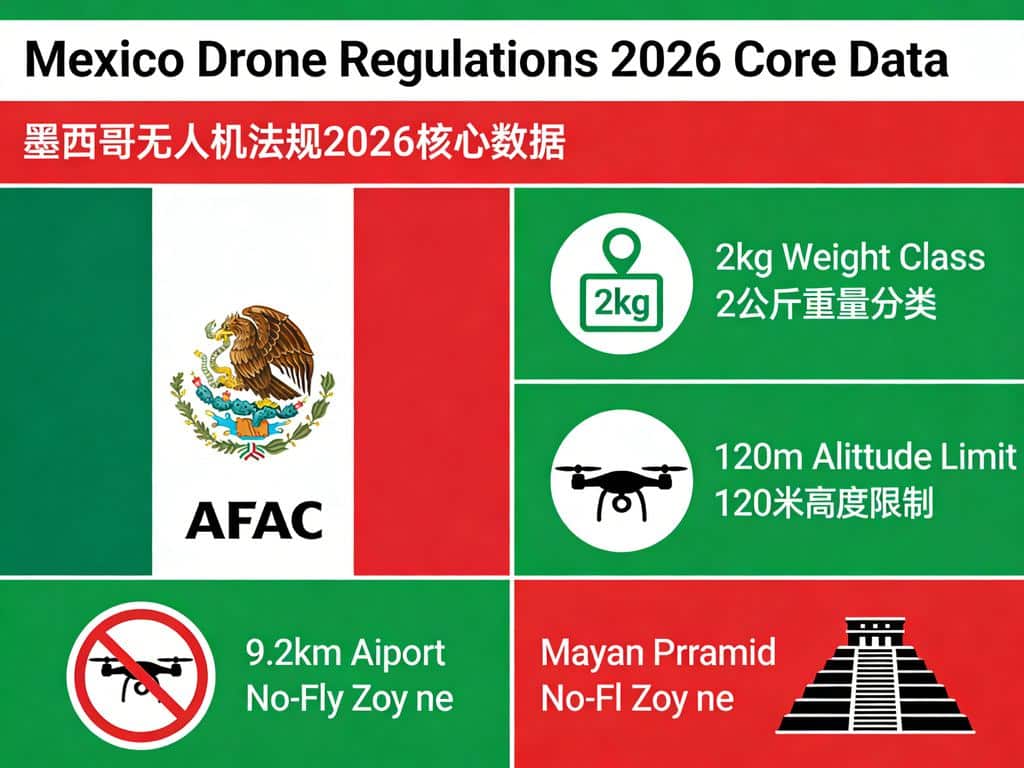
Infographic: Mexico Drone Laws 2026 (Registration, No‑Fly Zones, Penalties)
All Mexican archaeological sites (Chichén Itzá, Teotihuacán, Tulum, Palenque, Uxmal, etc.) are protected by the National Institute of Anthropology and History (INAH). Drones are strictly prohibited. Violators face confiscation, fines of up to 50,000 MXN, and possible deportation. In 2025, several tourists were caught flying near Chichén Itzá – their drones were seized and they were blacklisted .
Planning to capture stunning aerial footage of Mayan pyramids, Cancun’s Caribbean blue, Guanajuato’s colorful hills, or Mexico City’s Zócalo? Mexico’s drone regulations are relatively relaxed for sub‑2kg recreational drones, but archaeological site protections are extremely strict. This guide, reviewed by Mexican aviation lawyers and expat pilots, ensures you fly legally and avoid heavy fines or cultural conflicts.
2. Real Violation Cases (Tourists & Locals)
📌 Case 1: Chichén Itzá – Tourist drone confiscated (2025)
A tourist launched a drone near the Kukulkan Pyramid at Chichén Itzá. INAH staff spotted it, called the police, and the drone was seized. The tourist faced a 30,000 MXN (≈ $1,500 USD) fine and was blacklisted from Mexican archaeological sites.
📌 Case 2: Cancun – Flying at a public beach (2025)
A tourist flew a DJI Mini 3 Pro over a crowded beach in Cancun’s Hotel Zone. Local police warned him to land immediately and recorded his details. No fine was issued, but he was told not to fly over crowds.
📌 Case 3: Mexico City Airport – Undeclared drone at customs (2026)
A traveler did not declare his drone on arrival at Mexico City International Airport. Customs randomly inspected his luggage, found the drone, and imposed a 19% duty (approx. $2,500 MXN) to release it.
📌 Case 4: Guanajuato – Drone mistaken for surveillance (2025)
A tourist flew near the University of Guanajuato. Due to past incidents of cartel drone surveillance, locals called the police. Officers forced the tourist to delete all footage and warned of deportation for suspicious activity.
📌 Case 5: Los Cabos – Batteries confiscated at airport (2026)
A passenger placed three drone batteries in checked luggage at Los Cabos International Airport. Security detected them, confiscated the batteries, and the passenger nearly missed the flight.
3. Pilot Experience from English‑Speaking Expat Community in Mexico
4. AFAC Registration Process (Only for Drones >2kg)
Steps for tourists (skip this if your drone is under 2kg):
- 1. Determine if registration is needed: Under 2kg recreational – no registration needed . Over 2kg – must register.
- 2. Access the SCT online system: Via Mexico’s Ministry of Communications and Transportation (SCT) portal.
- 3. Prepare documents: Passport scan, purchase receipt, drone serial number, model, weight, and intended use.
- 4. Pay the fee: Approximately 500‑1000 MXN (about $25‑50 USD).
- 5. Wait for approval: Takes 15‑20 business days. You will receive a registration number to affix to the drone.
5. Mexico No‑Fly Zones (City‑Specific Rules)
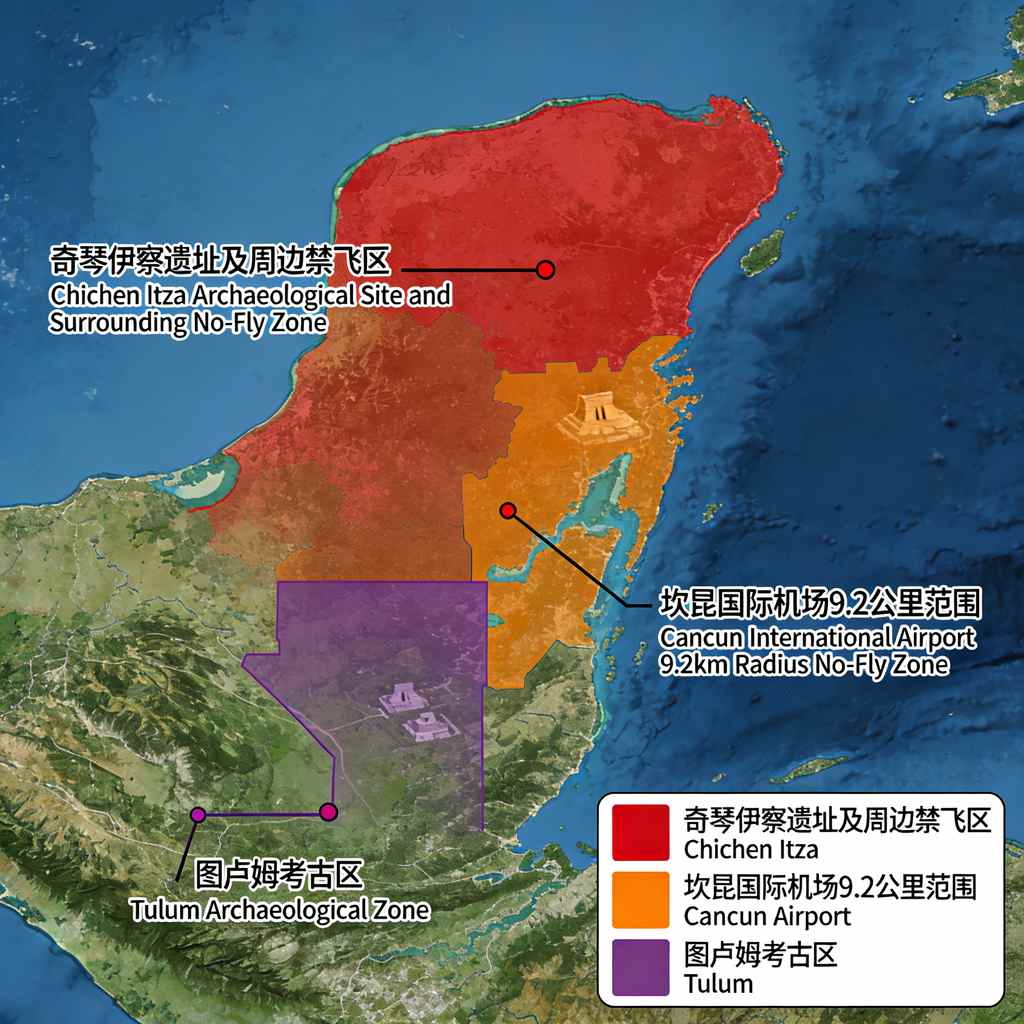
Map: Red areas are permanent no‑fly zones (airports, archaeological sites).
5.1 National Permanent No‑Fly Zones
- Airports: 9.2 km (5 nm) radius around all airports.
- Military & Government Sites: Military bases, federal police, presidential residence.
- Archaeological Sites (INAH): All Mayan ruins and pre‑Hispanic zones – absolute ban.
- National Parks & Biospheres: Some require permits (Copper Canyon, Sumidero, Sian Ka’an).
5.2 City‑Specific Rules (Popular Tourist Destinations)
🏝️ Cancún & Riviera Maya
- Airport zone: 9.2 km radius around Cancun International Airport covers most of the hotel zone – check before flying .
- Public beaches: Flying over crowded beaches is illegal. Early morning (before 8am) on less crowded beaches (Isla Mujeres north side, Puerto Morelos south side) may be allowed.
- Private resorts: You need permission from the hotel to fly over their property.
- Archaeological sites: Tulum, Cobá, El Rey – absolutely no drones.
🏛️ Mexico City
- Zócalo (Constitution Square): Forbidden – political center, heavy police presence.
- Airport zone: 9.2 km around Benito Juárez International Airport covers most of the city. Use AirMap before flying .
- Possible spots: Chapultepec Park (eastern edge, away from the castle), Xochimilco canals (weekday mornings, avoid crowds).
- Teotihuacán: Absolutely no drones over the pyramids (INAH protected).
🎨 Guanajuato
- Historic center: Narrow streets and many antennas; not recommended.
- El Pípila monument: The back side (away from the city) can be used, but avoid flying over the cable car lines or communication towers.
- Security sensitivity: Due to past drone incidents, avoid flying near the university or government buildings. Ask local permission first.
🏖️ Los Cabos
- Airport zone: Los Cabos International Airport has a 9.2km radius that covers much of San José del Cabo and parts of Cabo San Lucas – check map.
- Public beaches: Medano Beach is very crowded – avoid. Early morning on less busy beaches like Palmilla may be okay.
- Marine life: Avoid flying low over whales or sea lions (disturbing wildlife is prohibited).
🏞️ Oaxaca
- Monte Albán: INAH archaeological site – absolute no‑fly.
- Hierve el Agua: Natural rock formations – often allowed but check with local guides; no permanent ban but respect other visitors.
- City center: The Zócalo and Santo Domingo church – restricted due to government buildings.
5.3 Border States – Special Caution
- Northern border states (Chihuahua, Sonora, Coahuila, Nuevo León, Tamaulipas): Due to cartel drone activities for smuggling and surveillance, avoid flying drones in these areas unless you are in a well‑known tourist resort (e.g., Copper Canyon) and have local guidance. Tourists flying in remote border areas may be mistaken for illegal activity .
5.4 Recommended Safe Flying Locations
- Cancun area: North side of Isla Mujeres (early morning), Puerto Morelos south beach (weekday mornings), private resort grounds with permission.
- Mexico City: Chapultepec Park eastern edge (away from the castle), Xochimilco canals on weekday mornings.
- Los Cabos: Palmilla Beach (early morning), private villa grounds with permission.
- Guanajuato: Back side of El Pípila monument (avoid antennas).
- Oaxaca: Rural areas outside the city, e.g., Tlacolula valley (avoid archaeological zones).
6. Pre‑Trip & Pre‑Flight Checklist
✅ Before Departure (2‑4 weeks ahead)
- Check your drone’s weight. If over 2kg, start AFAC registration early (15‑20 business days).
- Keep purchase receipt and serial number handy for customs.
- Prepare fire‑proof bags for batteries.
- Research INAH archaeological sites on your route and mark them as no‑fly.
- Download AirMap or DJI Fly to check airport zones.
✅ After Arrival in Mexico (Before Each Flight)
- Declare your drone at customs (red channel) upon arrival .
- Check the map (AirMap / DJI Fly) to confirm you are outside 9.2km of any airport.
- Ensure you are not near an INAH archaeological site.
- Respect 120m altitude limit.
- Keep the drone within visual line of sight (VLOS).
- Avoid crowds, especially on beaches and plazas.
- If flying near the border, be extra cautious – some areas are sensitive.
- Carry all documents (passport, registration if applicable) with you.
7. Emergency: What to Do If You Violate the Rules
🆘 If Stopped by Police, AFAC, or INAH Officials
- Stay calm and cooperate: Show your passport and registration (if required).
- Do not delete data: Deleting footage may be seen as hiding evidence.
- Possible penalties:
- Undeclared drone at customs: 19% duty .
- Unregistered drone >2kg: 5,000‑20,000 MXN fine .
- Archaeological site violation: up to 50,000 MXN fine, confiscation, possible deportation .
- Border area suspicious flight: may involve federal police – request consular assistance immediately.
- Contact your embassy: Request consular assistance immediately.
- Emergency numbers: Tourist police: 911 · AFAC: +52-55-5723-9300 · US Embassy Mexico City: +52-55-5080-2000 · UK Embassy: +52-55-1670-3200.
8. Frequently Asked Questions (FAQ)
Can tourists bring drones to Mexico?
Yes. Declare it at customs. Drones under 2kg for recreational use do not need registration. Respect no‑fly zones, especially archaeological sites .
Does my DJI Mini (249g) need registration in Mexico?
No. Mexico exempts drones under 2kg for recreational use . Your DJI Mini is well under that limit. Just follow flight rules and no‑fly zones.
Can I fly over Chichén Itzá?
Absolutely not. All Mexican archaeological sites are strictly prohibited. Violators face confiscation and heavy fines .
Can I fly a drone at Cancun beaches?
Public beaches are crowded – flying over people is illegal. Best to fly early morning on less crowded beaches like north Isla Mujeres, or get resort permission .
How do I declare my drone at Mexican customs?
After landing, go to the red channel (Declarar). Tell the officer you have one drone for personal use. Keep your purchase receipt handy. One drone is duty‑free .
Is drone insurance required in Mexico?
Not mandatory for recreational flights, but strongly recommended (liability coverage).
Can I fly in Mexico City’s Zócalo?
No. The Zócalo is a political and security zone with heavy police presence. Do not attempt .
Are there any restrictions on flying near the US‑Mexico border?
Yes. Northern border states have cartel drone activity. Avoid flying there unless you are in a well‑known tourist area (e.g., Copper Canyon) and have local advice .
What should I do if I lose my AFAC registration certificate?
Log into the SCT online system and download a new copy. Digital copies are acceptable.
Can I fly a drone over a cenote (natural sinkhole) in Yucatán?
Many cenotes are on private property. You need the landowner’s permission. Some cenotes are within protected areas – check local signs.
Other destination guides: Thailand · Germany · the United States · Australia · New Zealand · Japan · Britain · Indonesia · Italy
📚 Official References
- Mexican Federal Civil Aviation Agency (AFAC): https://www.gob.mx/afac
- NOM-107-SCT3-2019 – Official drone operating standards
- Mexican Customs (SAT) – Electronic device regulations: SAT
- National Institute of Anthropology and History (INAH) – Archaeological site protections
- US Embassy Mexico – Travel & drone guidance
📝 Changelog
- v1.0-en | April 2, 2026: English version released. Fully adapted to Mexico’s drone laws with city‑specific rules for Cancun, Mexico City, Guanajuato, Los Cabos, Oaxaca. Includes 2kg registration threshold, Mayan ruins ban, customs declaration tips. Reviewed by native English‑speaking aviation experts.
⚠️ Legal Disclaimer
1. This guide is based on information from AFAC, INAH, and Mexican customs as of April 2026. Regulations may change without notice. Always verify with official sources before flying.
2. We are not a Mexican government agency. This content is for informational purposes only and does not constitute legal advice. For specific legal questions, consult a qualified aviation attorney.
3. Any flight activity based on this guide is at your own risk. UAVwiki and its experts assume no liability for fines, confiscation, or legal consequences.
4. This guide applies to recreational drone use. Commercial operations require additional permits.
Laws change frequently – always double‑check before flying. Archaeological sites are strictly off‑limits!
© UAVwiki 2026 | Languages: English |
简体中文 |
Français |
Español |
Deutsch
Prepared by UAVwiki Americas Aviation Experts | Published April 2, 2026

Leave a Reply